Monday, January 31, 2011

Section 9.1: Sequences

A sequence is defined as a function whose domain consists of natural numbers.  

The function values

are the terms of the sequence. 

Finding the Terms of a Sequence

  • To find the sequence's recursive formula, look at the first few terms. Then use previous terms to define all other terms


(next = now + 5)

  • To find the sequence's explicit formula, look for an apparent pattern. 
Factorials
If n is a positive integer, n factorial is defined by

n! = 1 • 2 • 3 • 4 ... (n - 1) • n

Here are some values of n!:
0! : 1
1! : 1
2!: 1 • 2 • = 2
3!: 1 • 2 • 3 = 6

Common Sequences
Some sequences occur more frequently than others. Some common sequences include:
  • Powers of 2: 2, 4, 8, 16...
  • Powers of 3: 3, 9, 27, 81...
  • Perfect Squares: 1, 4, 9, 16...
  • Factorial Numbers: 1, 1, 2, 6, 24...

Pre Calc Section 7.2

This section contains information on Summation Notation.

A sequence is an ordered list of numbers

The domain of a sequence must be natural numbers, as opposed to a function, which has the domain of all real numbers.

Sigma Notation/Summation Notation

F(i)= is the explicit formula for a sequence you are taking the sum of.

n= the upper limit

i=1 is the lower limit


F(i)=F1+F2+F3+F4+..................F(N)

You take the sum, starting from the lower limit (1), until you hit the upper limit (N).

YOU DONT HAVE N # OF TERMS, YOU STOP SUMMATION WHEN YOU HIT THE NTH TERM!

To solve in graphing calculator

SUM(SEQ(explicit formula, variable, lower limit, upper limit))

Sigma Takes Commas out and turns them into pluses.

FORMS A SERIES

Partial Sums


Let N = 5

Series Starts at 1 and goes until N, in this case 5.

S15=15th Partial Sum


Wednesday, January 26, 2011

Section 7.1

This section is all about solving systems of equations and the different ways it can be done!

There are 3 main ways to solve a system of equations...
1) Substitution
2) Elimination
3) Graphing

Substitution
Example:
x + y = 4
2x + 1 = y

By plugging the second equation into the first we can conclude that:

x + (2x+1) = 4
3x + 1 = 4
3x = 3
x = 1

Some simple steps for substitution include...
1. Solve one equation for one variable in terms of the other
2. Substitute the expression found in step 1 into the other equation to obtain an equation in one variable
3. Solve the equation obtained in step 2
4. Back- substitute the solution in step 3 into the expression obtained in step 1 to find the value of the other variable
5. Check that the solution satisfies each of the original equations

Elimination
Example:
3x + 5y =10
2x - 5y = 5

Given this set of equations, we can elimate the 5y and -5y and solve the equation...

3x = 10
2x = 5
_______
5x = 15
x = 3

Remember a few easy steps when solving a system of equations using elimination:
1. Obtain coefficients for x (or y) that differ only in sign by multiplying all terms of one or both equations by suitably chosen constants
2. Add the equations to eliminate one variable; solve the resulting equation
3. Back- substitute the value obtained in Step 2 into either of the original equations and solve for the other variable
4. Check your solution in both of the original equations

Graphing
Graphing to find the solution of a system of equations comes in handy when the set is too challenging to solve algebraically. It should not be a first resort when solving the system though. When you graph the two equations, remember the solution is where the two graphs intersect!

Tuesday, January 18, 2011

Exponential and Logarithmic Wrap-Up

One to One:
Exponential:
2^x = 2^3x-1 original problem
x = 3x-1 because they are one to one, you can disregard their base
1/2 = x solve
Logarithmic:
log(x-4) - log(3x-10) = log(1/x) original problem

use the logarithmic laws

because they are one to one, you can disregard the logs


continue solving

Inverse (key to everything):
Exponential:
e^x-5 = 0
lne^x = ln 5
x = ln5
use calculator
Logarithmic:


take 10 to the power of each side (exponentiation)


continue solving

Monday, January 17, 2011

Solving Exponential and Logarithmic Equations

One-to-One Properties:


if and only if x=y

if and only if x=y


Inverse Properties:


=x


=x


Solving Exponential and Logarithmic Equations

- rewrite the equation using one to one properties

Ex.


x=3


- rewrite an exponential equation as a logarithmic equation and use the inverse properties

Ex.


since there is an e in the equation, we use natural log (ln) rather than log


the ln cancels out the e since an e is already included when we use ln


x= ln5


-Rewrite a logarithmic equation as an exponential equation and use the inverse properties


log x= 2

10^(log x) = 10^2


the 10 and the log cancel out


x= 10^2

x=100


Examples from class:

Ex. 1

2+3^(x-4) = 12


subtract the 2


3^(x-4) = 10


change to a logarithmic equation ( the exponent (x-4) will be multiplied by the logarithm)


(x-4) log 3= log 10


log 10 is equal to one (10^1 = 10)


(x-4) log 3= 1


divide by the logarithm


(x-4) = 1/(log 3)


add the 4


x= 1/(log 3) + 4


solve using a calculator


x= 6.10


Ex. 2

e^(2x) - 3e^x +2 = 0

let u = e^x


u^2 - 3u + 2 = 0


factor the equation

(u-1)(u-2) = 0


u=1 u=2

e^x=1 e^x=2

x=0 ln(e^x) =ln 2

x=.7


Wednesday, January 12, 2011

Exponential Functions, Logarithmic Functions and Their Graphs

Definition of Logarithmic Functions:


         - eq=y=log_ax      can also be written as  eq=x=a^y...... they are equivalent.

The logarithmic function is called log base a


ex.   eq=log_327=x ........ which is the same as........ eq=3^x=27

       Then solve for x....... which is 3

Properties of Logarithms:


1. eq=log_a1=0    because    eq=a^0=1

2. eq=log_aa=1     because    eq=a^1=a

3. eq=log_ax =log_ay , then x = y  ----------- One-to-One property
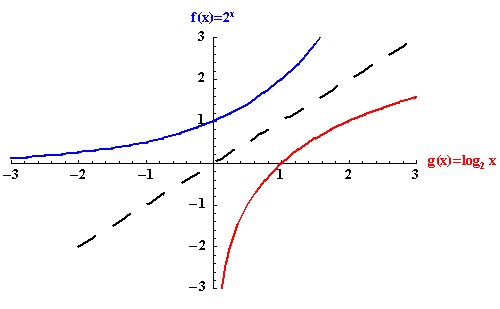
Transformations of Graphs of Logarithmic Functions:


The graphs of logarithms are the same as the graphs for exponents but they are reflected over the line of y = x.
The transformations for logarithmic graphs are the same as transformations for any other kinds of graphs.


The best way to show this is in an example.


Ex.  eq=f(x)=log_e(x-1)+2
    - The transformations for this graph are the same as for any other graph
            - Moved to the right 1, and moved up 2.

Natural Logarithms:


The function is defined as:

        eq=f(x)=log_ex=ln x ,   x > 0     This is called the natural logarithmic function.


Properties of Natural Logarithms:


1. eq=ln1=0  
     because   eq=e^0=1
2. eq=lne=1     because    eq=e^1=e
3. eq=lnx=lny, the x=y  ------ One-to-One Property

James Thomas

Logarithms Part 2

The Three Laws of Logarithms are:


You can derive the first law listed by starting with something that you know...


then just multiply together...


Using The Key to Everything, you can again see that


The Change of Base formula:


Example:


(use the key to everything)


(take the log of both sides)


(use the 3 laws of logarithms to solve)